Ⅰ.Overview
The OpenVox Unified Communications Platform (UCP) is an ideal all-in-one solution for integrating data, voice, and video, designed for small and medium-sized enterprises. It can be widely deployed in government and enterprise call systems, commercial call centers, and dispatch centers.
The core philosophy of UCP is that users can select business modules and control modules with different functions and performance levels according to their own needs. These modules are connected to the backplane via a high-speed Ethernet network through dedicated communication connectors.
The OpenVox Unified Communications Platform is not merely a single VoIP gateway or IPPBX product, but rather a unified communications platform covering a full range of telecom interfaces and IPPBX functions.
UCP supports multiple interface types including FXS/FXO/GSM/WCDMA/LTE/E1/T1/Audio/Radio and magneto interfaces, and supports CPU control modules based on the general-purpose X86 architecture, which can be flexibly installed in IPPBX systems or other business systems.
Ⅱ.Competitive Advantages
 Multiple carrier-grade interface modules: GSM / LTE / Analog / E1 & T1 / Audio / Intercom / Magneto interfaces, meeting access requirements for various scenarios.
 Hot-swap design supported; modules can be flexibly expanded and replaced to ensure zero-downtime upgrades.
 Carrier-grade hardware and software platform, stable and reliable, suitable for mission-critical business scenarios.
 Dual redundant power supply design with automatic failover to improve system availability.
 High-availability architecture with load balancing support to ensure continuous service under high concurrency.
 Multi-node clustering and failover mechanism to ensure continuous operation of core services.
 Modular architecture with flexible combinations on demand, facilitating future expansion and functional upgrades.
 Supports both single-node independent deployment and distributed network deployment, adaptable to different scale networks.
 Friendly and intuitive user interface; new users can quickly get started with configuration and O&M.
 Full hot-swap support; fault localization and module replacement are efficient and convenient, reducing maintenance time.
Ⅲ.Model Parameter Comparison
(1)Performance Parameter Overview
(2)Physical Parameter Overview
| Parameter |
UCP1202 |
UCP1600 |
UCP2120 |
UCP4131 |
| Dimensions |
50mm(H) ×188mm(W) × 202mm(D) |
44mm(H) ×434mm(W)× 330mm(D) |
88mm(H) ×434mm(W)×330mm(D) |
176.8mm(H) ×435.8mm(W)× 330mm(D) |
| Weight |
1.5kg |
3.9kg (with CSU-F + 5× blank panels) |
5.6kg (with CSU-F + 11×
blank panels) |
9.6kg(with CSU-F + 11× blank panels + 2× PSU) |
| Max Power Consumption (Full Config) |
< 36W |
< 64W |
< 170W |
< 340W |
| Input Voltage (AC Power) |
\\ |
100V ~ 240V AC |
| Input Current (AC Power) |
Input Current (DC Power): 3A |
1A |
2A |
4A |
| Power Frequency (AC Power) |
\\ |
50Hz/60Hz |
| Max Output Power (AC Power) |
36W |
75W |
200W |
400W |
| Input Voltage (DC Power) |
12V |
Not supported |
-48V ~ -60V |
| Subscriber Line Distance |
3.0km (when telephone sets are not connected in parallel) |
| Storage Temperature |
-40°C ~ 70°C |
-20°C ~ 70°C |
| Long-term Operating Temperature |
0°C ~ 50°C |
| Short-term Operating Temperature |
-5°C ~ 55°C
Note: Short-term operation refers to continuous operation not exceeding 12 hours and no more than 8 days accumulated per year. |
| Ambient Humidity |
5% ~ 95% RH, non-condensing |
| Airborne Particle Concentration |
Less than 180 mg/m³ |
(3)Series Product Structure Details
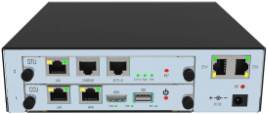
- UCP1202
| Product Dimension |
Key Information |
| Appearance & Specs |
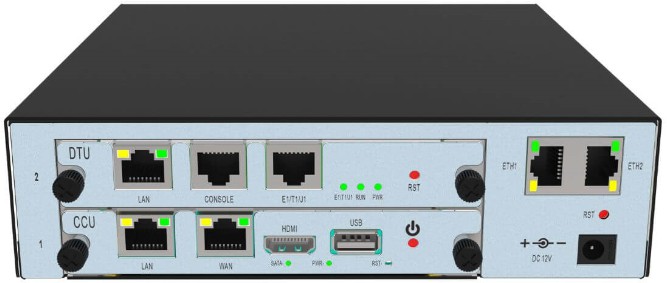
- Dimensions: W 188mm × D 202mm × H 50mm
- Form Factor: Desktop sheet-metal chassis, compact size, space-saving.
|
| Positioning & Capacity |
- User Capacity: Serves up to 100 users.
- Application Scenarios: Core voice switching for SMEs, local access gateway for branch offices.
- Business Expansion: Supports analog (FXS/FXO), digital (E1/T1), wireless (GSM/LTE), intercom, and broadcast interface expansion.
|
| Slot Configuration |

- Slot 1 (Control): Must and can only install 1 CCU-N-ALDER control board.
- Slot 2 (Service): Provides 1 general-purpose service board slot for expanding various voice or storage cards.
|
| Configuration Rules |
- Basic Principle: Must have 1 control board installed to operate normally.
- IP Address Recognition: General-purpose service boards (except ACU/RIU) automatically recognize the initial IP based on slot number; Slot 2 corresponds to IP 172.16.80.2 .
- Empty Slot Handling: Unused slots must be fitted with blank panels to ensure dust protection and heat dissipation.
|
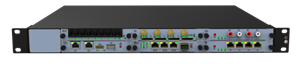
2.UCP1600
| Product Dimension |
Key Information |
| Appearance & Specs |

- Dimensions: W 434mm × D 330mm × H 44mm
- Form Factor: 1U standard rack-mount chassis, suitable for installation in server cabinets.
|
| Positioning & Capacity |
- Application Scenarios: Core unified communications for SMEs, high-density access gateway for branch offices.
- Full Interface Support: Fully supports analog (FXS/FXO), digital (E1/T1), mobile (GSM/LTE), and intercom/broadcast/magneto interface expansion.
|
| Slot Configuration |

- Slot 1 (Control): Must and can only install 1 CCU-N-ALDER control board.
- Slots 2–5 (Service): Provides 4 general-purpose service board slots, supporting mixed insertion of various service boards with strong expandability.
- Hard Drive Expansion: To expand storage, the SEU hard drive board must be installed in
Slot 2, supporting 1× 2.5-inch hard drive. |
| Configuration Rules |
- Basic Principle: Must have 1 control board installed to operate normally.
- IP Address Recognition: General-purpose service boards (except ACU/RIU) automatically recognize the initial IP based on slot number; Slot 2 corresponds to 172.16.80.2 , and so on.
- Empty Slot Handling: Empty slots without service boards must be fitted with blank panels.
|
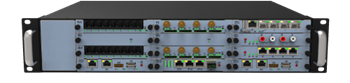
3.UCP2120
| Product Dimension |
Key Information |
| Appearance & Specs |
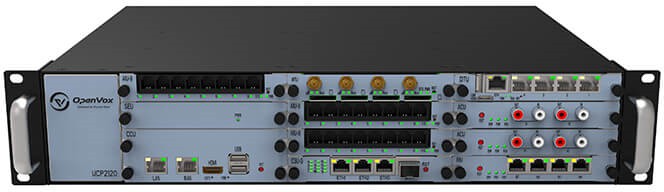
- Dimensions: W 434mm × D 330mm × H 88mm |
- Form Factor: 2U standard rack-mount chassis, providing higher-density slot support.
|
| Positioning & Capacity |
- Application Scenarios: Core switching for medium-sized enterprises, high-capacity branch access gateway.
- Expansion Capability: Supports mixed insertion of more telecom interfaces, meeting complex networking requirements.
|
| Dual Control Board Design |
- Slots 1 & 8: Provides 2 control board slots, supporting installation of all CCU control board models.
- Configuration Strategy:
- Single control board: Installed in Slot 1 by default.
- Dual control boards: Can achieve high-reliability redundancy (requires software support).
- Mixed use: Slot 8, when not occupied by a control board, can be used as a regular service slot.
|
| Service Slots |
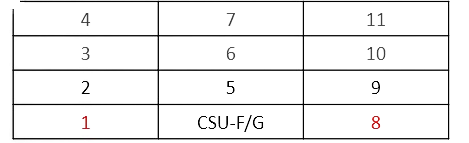
- Slot Distribution: Provides 9 service board slots (Slots 2–7, 9–11).
- Hard Drive Expansion:
- Single drive: When control board is in Slot 1, SEU board goes in Slot 3; when in Slot 8, it goes in Slot 10.
- Dual drives: Supports dual hard drive expansion, occupying Slots 3/4 or 10/11 respectively.
|
| Configuration Rules |
- Basic Principle: At least 1 control board must be installed.
- IP Address Recognition: General-purpose service boards (except ACU/RIU) automatically recognize the initial IP based on slot number; Slot 2 corresponds to 172.16.80.2 .
- Empty Slot Handling: Unoccupied slots must be fitted with blank panels.
|
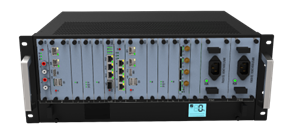
4. UCP4131
| Product Dimension |
Key Information |
| Appearance & Specs |
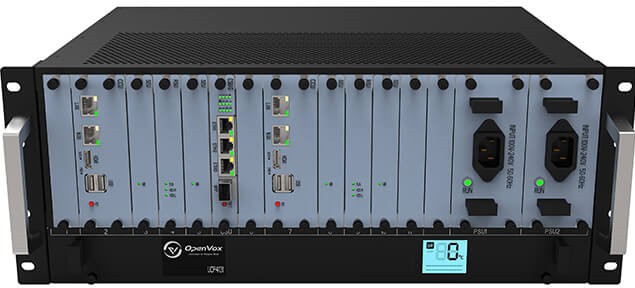
- Dimensions: W 435.8mm × D 330mm × H 176.8mm
- Form Factor: 4U standard rack-mount chassis, providing maximum expansion space.
|
| Positioning & Capacity |
- Application Scenarios: Core dispatch host for large enterprises, regional tandem gateway, carrier-grade access.
- High Reliability: Supports dual hot standby, distributed clustering (requires software), RAID storage redundancy, and dual power supply redundancy.
|
| Slot Configuration |
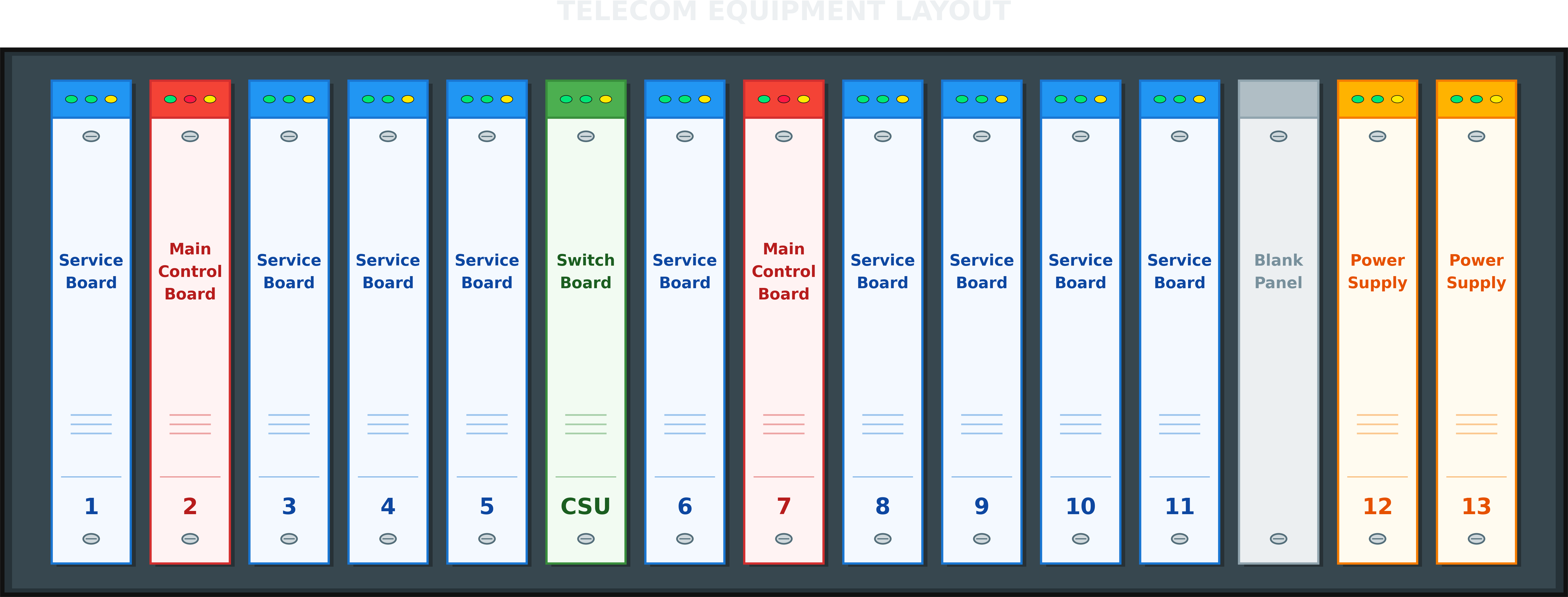
- Total Slots: Provides 13 physical slots.
- Control Slots: Slots 2 and 7. Slot 7, when not occupied by a control board, can be used as a service slot.
- Service Slots: Provides 9 service board slots (Slots 1, 3–6, 8–11).
- Power Slots: Provides 2 redundant power supply slots (Slots 12, 13).
|
| Dual Control Board Design |
- Single Control Board Mode: Operates with only one control board installed.
- Dual Control Board Mode: When two control boards are installed, hardware-level redundancy is achieved, significantly improving system reliability.
|
| Configuration Rules |
- Basic Principle: At least 1 control board must be installed.
- Mixed Insertion Support: All service boards support mixed insertion in any service slot.
- Exclusive Feature: Only this model supports RAID card (RSU) and redundant power supplies.
|
Ⅳ.Unit Boards
Introduction to the various unit board types of the Unified Communications Platform.
| Type |
Unit Board Model |
Brief Description |
Interfaces Provided |
Compatible with the Following Chassis |
| UCP1202 |
UCP1600 |
UCP2120 |
UCP4131 |
| Switch Board |
CSU-F |
Network switch board with 100M port speed |
2× 100M Ethernet ports |
No |
Yes |
Yes |
Yes |
| CSU-G |
Network switch board with 1000M port speed |
3× Gigabit Ethernet ports, 1× SFP port |
No |
Yes |
Yes |
Yes |
| Control Board |
CCU-I- ALDER |
Control board using a 3.40GHz Intel quad-core N100 processor, occupies only 1 slot, uses onboard M.2 SSD by default |
2× Gigabit
Ethernet ports, 1×
HDMI, 1× USB 3.0 |
Yes |
Yes |
Yes |
Yes |
| CCU-I- TGL |
Uses Intel 11th Gen quad-core i5/i7 processor, requires 2 slots, uses onboard M.2 SSD by default, supports up to 2 hard drive boards |
3× Gigabit Ethernet ports, 1× HDMI, 2× USB 3.0, 1× RST button |
No |
No |
Yes |
Yes |
| RAID
Module Board |
RSU |
RAID controller card, supports RAID 1 mode |
2× SATA interfaces |
No |
No |
No |
Yes |
| Storage Expansion Board |
SEU |
Hard drive expansion board, supports one 2.5- inch HDD or SSD |
1× SATA interface |
No |
Yes |
Yes |
Yes |
| General Service Board |
AIU-8 |
Analog interface board, supports FXO/FXS
interfaces |
8× FXS/FXO
interfaces |
Yes |
Yes |
Yes |
Yes |
| AIU-16 |
Analog interface board, FXS interfaces only |
16× FXS
interfaces |
Yes |
Yes |
Yes |
Yes |
| WTU |
Wireless interface board, supports GSM/WCDMA/LTE
wireless access |
4× GSM/WCDMA/LTE
interfaces |
Yes |
Yes |
Yes |
Yes |
| DTU |
Digital trunk board, supports E1/T1/J1 trunk line access |
1/2/4× E1/T1/J1
interfaces 1× Gigabit
Ethernet port
1× Mini HDMI, 1×
USB 2.0 |
Yes |
Yes |
Yes |
Yes |
| ACU |
Audio broadcast service board, supports RCA jack audio input/output |
2× audio input/output interfaces |
Yes |
Yes |
Yes |
Yes |
| RIU |
Wireless trunking service board, supports wireless paging and intercom |
2/4× wireless interfaces |
Yes |
Yes |
Yes |
Yes |
(1)Switch Board
Interfaces and Appearance
1U Chassis UCP1600 Switch Board (CSU-F)

2U Chassis UCP2120 Switch Board (CSU-F)

2U Chassis UCP2120 Switch Board (CSU-G) with SFP Interface
| Feature Dimension |
Detailed Characteristics |
| Flexible Model Selection |
- CSU-F (100M version): Suitable for 1U (UCP1600) and above chassis, provides basic network switching capability with high cost-effectiveness.
- CSU-G (Gigabit version): Suitable for 2U (UCP2120) and above chassis, provides gigabit- speed high-speed switching capability to meet large data throughput demands.
|
| Rich Interface Configuration |
- CSU-F Interfaces: Provides 2× 100M ETH ports for connecting to external networks or cascading devices. Provides 1× CONSOLE debug port and 1× RST reset button.
- CSU-G Interfaces: Provides 3× Gigabit (1000M) ETH ports, significantly increasing network
access bandwidth. Provides 1× SFP optical port, supporting fiber access for long-distance transmission or connection to core switches. |
| Internal Switching Architecture |
- Backplane Switching: Directly connects to the chassis backplane via rear-facing ports, forming an internal LAN with the control board and service boards — no external cabling required.
- Plug-and-Play: All 3 models (UCP1600/2120/4131) come with CSU-F as standard; users can flexibly upgrade to CSU-G based on network requirements.
|
(2)Control Board
| Category |
Parameter |
CCU-I-TGL (High-Performance Control Board) |
CCU-N-ALDER (Standard Control Board) |
| Product Positioning |
Processor Architecture |
Intel Quad-Core X86 Architecture Processor |
| Recommended Use Case |
High-Density / Large-Capacity Scenarios
Lab concurrent calls: 1800 (G.711) / 1000 (G.729) |
Small and Medium Enterprise Scenarios
Recommended users < 800, recommended concurrent calls < 200 |
| Software Ecosystem |
Protocol Support |
IP side: SIP / IAX2; CPE side: BRI / PRI / SS7 / R2 / GSM / WCDMA, etc. |
| Compatible Platforms |
OpenVox UC PBX, Asterisk, FreePBX, 3CX, Issabel, VitalPBX, etc. |
| Lab Performance (Peak Concurrent) |
G.711 (ulaw) |
3200 channels |
2000 channels |
| G.729 |
1250 channels |
620 channels |
| Hardware Interfaces |
Front Panel Interfaces |
LAN, WAN, HDMI, USB, SATA |
LAN, WAN, HDMI, USB |
(3)Service Boards
3.1 AIU — Analog Interface Unit Board
Interfaces and Appearance
AIU-8: Each module provides 8× FXO / 8× FXS, RJ11 interfaces

AIU-16: Each module provides 16× FXS, FXO not supported, RJ21 interfaces

| Feature Dimension |
Detailed Characteristics |
| Seamless Unified Communications |
- Hybrid Networking Capability: Used with the UCP platform to achieve perfect integration and smooth transition between VoIP networks and traditional PSTN networks.
- High Compatibility: 100% compatible with Asterisk, 3CX, FreePBX, FreeSWITCH, and VOS and other mainstream softswitch platforms.
- Full Codec Support: Supports G.711(U/A), GSM, G.722, G.726, G.729A and other codecs to ensure high-quality voice service.
|
| Flexible Interface Configuration |
- Multiple Models Available: Offers AIU-8 (8-port) and AIU-16 (16-port) series to meet different scale analog access requirements.
- Rich Interface Types:
- AIU-8: RJ11 interface, supports 8FXO / 8FXS / 4FXO+4FXS mixed configurations.
- AIU-16: High-density RJ21 interface, provides 16 FXS ports (FXO not supported).
|
| Professional Fax & Voice |
- High-Fidelity Fax: Supports T.38 fax relay and T.30 fax passthrough, ensuring stable and clear multi-page continuous fax transmission.
- Intelligent Voice Processing: Built-in echo cancellation, static jitter buffer, VAD (Voice Activity Detection), and CNG (Comfort Noise Generation) to improve call quality.
- Advanced Features: Supports Caller ID, MWI (Message Waiting Indicator), call hold/transfer/waiting, and custom dial plans.
|
| Convenient O&M Management |
- Efficient Deployment: Supports DHCP, DNS/DDNS, TFTP, and NAT networking, with automated configuration and bulk deployment capabilities.
- Open Architecture: Provides open API interfaces, supports custom scripts, facilitating secondary development and system integration.
- Visual Configuration: All parameter settings can be completed through a user- friendly Web interface, with support for gain adjustment and volume control.
|
3.2 WTU — Wireless Unit Board
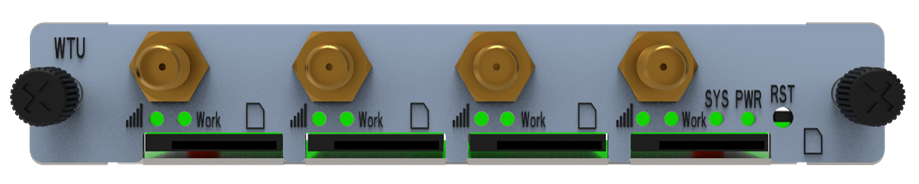
WTU-1 wireless module provides 4G connectivity support for UCP1600/2120/4131 series chassis. Each module supports 4 4G channels.
| Feature Dimension |
Detailed Characteristics |
| Full-Network 4G Connectivity |
- High-Speed Wireless Access: Supports LTE connection to VoIP devices, enabling high-quality voice communication without relying on wired networks.
- Multi-Channel Concurrency: Each module provides 4× 4G channels, supporting multi- channel concurrent calls and SMS sending/receiving.
- Emergency Communication Backup: Can serve as a reliable backup link when wired networks are interrupted, ensuring critical business communications are uninterrupted.
|
| Powerful SMS Features |
- SMS Marketing & Notifications: Supports SMS bulk sending, SMS to email, SMS forwarding, and remote SMS control to meet enterprise marketing and system alert needs.
- Convenient Development Interfaces: Provides SMS API, USSD, and USSD API for easy secondary development and system integration.
- Flexible Encoding Support: Supports multiple SMS encoding formats to ensure accurate delivery of content in different languages.
|
| Professional Voice & Management |
- Rich Call Control: Supports call duration limits, call count limits, blacklist management, call waiting/transfer, and call statistics.
- HD Voice Codecs: Compatible with G.711-ulaw/alaw, GSM, G.722, G.726, G.729, and other codecs to adapt to different bandwidth environments.
- Refined Operations: Supports PIN verification, balance inquiry, number inquiry, and CDR (Call Detail Record) logging for cost management.
|
| Convenient O&M Features |
- Flexible Network Configuration: Supports SIP/IAX2 protocols with flexible wireless group settings.
- Remote Management Capability: Supports online firmware updates, Syslog remote logging, and SIP/RTP packet capture to greatly simplify O&M work.
- Data Security Backup: Supports configuration file backup and restore to ensure system configuration security.
|
3.3 DTU — Digital Trunk Unit Board


| Feature Dimension |
Detailed Characteristics |
| High Concurrency & High Performance |
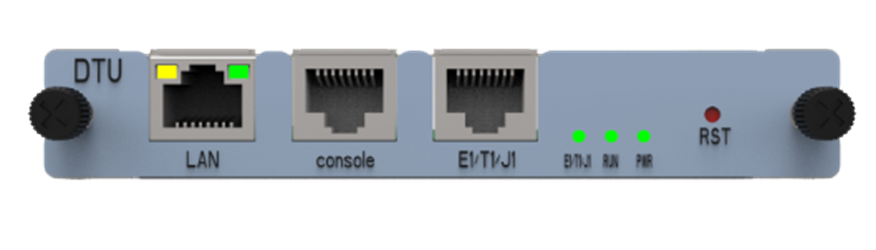
- Multiple Interface Specs: Available in 1/2/4 T1/E1 interface versions, flexibly adapting to trunk access requirements of different scales.
- Large Concurrent Capacity: Supports up to 120 concurrent calls (4E1) per board, meeting the high traffic demands of large and medium call centers.
|
| Comprehensive Signaling Support |
- Full Protocol Coverage: Perfectly supports PRI, SS7 (Signaling System 7), and R2
signaling, meeting interconnection requirements with different carriers.
- Global Adaptation: Supports R2 signaling standards for up to 24 countries, with continuous additions, suitable for global deployment.
- Broad Codec Compatibility: Supports G.711(A/U), G.729A, G.723.1, G.722, G.726, iLBC, Opus, AMR, and other mainstream audio codecs.
|
| Professional O&M & Development |
- Open API Interface: Fully open API (Asterisk Manager Interface), facilitating secondary development and feature customization.
- Network & Security: Supports SIP/TCP/UDP/RTP protocols, integrates HTTPS secure access.
|
| Convenient Configuration Experience |
- Web Visual Configuration: Features a clean and easy-to-use Web management interface for effortless gateway parameter configuration.
- Plug-and-Play Design: Independent gateway module design, simple to deploy with no complex system integration required.
|
3.4 ACU — Audio Broadcast Unit Board
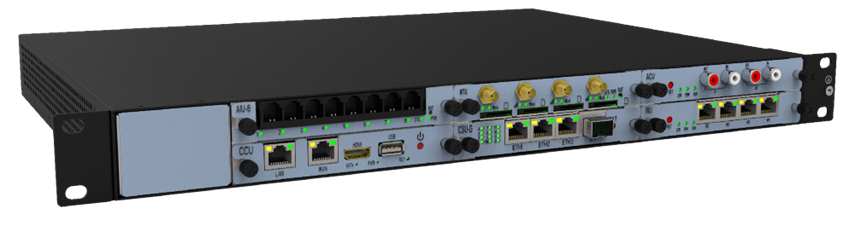
ACU audio broadcast unit board, 2-in/2-out, RCA jack interfaces

Full unit render — can be used standalone as a gateway
| Feature Dimension |
Detailed Characteristics |
| Audio Interconnection & Control |
- Multi-Source Audio Interface: Provides 2× input / 2× output RCA jack interfaces, connectable to microphones, mixing consoles, amplifiers, speakers, and other audio devices.
- Two-Way Voice Transmission: Enables voice sending/receiving from phones and microphones to be amplified and transmitted over telephone lines, supporting integration of remote phone voice into local broadcast systems.
- Flexible Control Capability: Features powerful telephone access control, allowing users to connect different external devices to achieve personalized audio playback and broadcast control.
|
| Ultimate Audio Quality |
- Professional Noise Reduction: Built-in echo suppression and noise suppression technology provides unparalleled noise elimination for clear and pure voice.
- Patented Voice Algorithm: Uses OpenVox’s proprietary patented voice processing algorithm to ensure high-quality voice calls even in complex environments.
- Synchronous Dual Output: Supports simultaneous output of two audio signals to meet multi-zone broadcasting or backup recording needs.
|
| Unified Communications Applications |
- Multi-Network Convergence Access: Features powerful multi-line telephone processing capability, supporting mixed access of SIP, PSTN, and GSM lines.
- Video Conferencing: Optimized for conference scenarios, ensuring clear voice quality in video conferences and solving audio access challenges of traditional conferencing systems.
- High Cost-Effectiveness: Uses 1U standard design to save deployment space, providing a simple system integration solution at a moderate cost.
|
| Convenient Configuration Management |
- Web Visual Configuration: All parameter configurations can be done through a user- friendly Web management interface; simple to operate without requiring a professional audio engineer.
|
3.5 RIU — Wireless Trunking Unit Board
RIU wireless trunking unit board, 2-channel/4-channel selectable, RJ45 interfaces

| Feature Dimension |
Detailed Characteristics |
| Unified Communications Capability |
- Bidirectional Interconnection: Enables two-way voice communication between telephone terminals (PSTN/SIP) and wireless radios (handheld/vehicle-mounted).
- Hybrid Line Support: Simultaneously supports traditional PSTN telephone line access and SIP-based VoIP line access.
- Standard Protocol Integration: Based on standard SIP protocol, seamlessly integrates with mainstream IP-PBX, softswitches, and dispatch command systems.
|
| Deployment & Compatibility |
- Broad Device Compatibility: Perfectly compatible with mainstream brand handhelds and vehicle radios including Motorola and Kenwood.
- Flexible Deployment Forms: Supports mixed insertion as a UCP platform service board, or standalone deployment as an independent gateway.
- Standardized Interfaces: Available in 2-channel/4-channel configurations, using RJ45 standard interfaces and professional control cables for plug-and-play operation.
|
| Audio Processing Technology |
- Proprietary Voice Algorithm: Voice processing algorithm developed from multi- party communication experience, with call clarity and fidelity superior to comparable products.
- Intelligent Anti-Clipping Technology: Built-in voice delay buffer mechanism effectively solves word and speech clipping issues when VOX is enabled.
- Fully Adjustable Parameters: Supports input/output volume adjustment, line level control, and VOX (Voice Activation) sensitivity adjustment.
|
| Professional Dispatch Control |
- Advanced Signaling Support: Supports COR/PTT valid signal detection and user- defined settings.
- Emergency Preemption: Supports SIP INFO preemption function, meeting emergency command and dispatch scenario requirements.
- Diverse Call Modes: Supports analog trunking unicall, group call, and various dialing and digit collection rule configurations.
- Hotline Call: Supports PTT hotline call function — press to connect.
|
3.6 RSU — RAID Card Unit Board
RAID module unit, supports RAID 1, RAID functionality is only supported in the 4U chassis.

| Feature Dimension |
Detailed Characteristics |
| High Performance & Reliability |
- Redundant Backup (RAID 1): Uses data mirroring technology; when the primary hard drive suffers physical damage, the mirror drive takes over seamlessly, ensuring zero data loss and uninterrupted service.
|
| Flexible Deployment Architecture |
- Combination Expansion: Requires two SEU (hard drive expansion boards) to build a complete RAID storage system.
- Dedicated Chassis Support: This feature is designed for high-reliability scenarios and currently only supports the 4U chassis (UCP4131) to ensure ultimate stability of high-end equipment.
- Independent Module Design: An independent RAID control unit reduces the burden on the main control CPU, further improving overall processing efficiency.
|
| Convenient Management & Monitoring |
- Real-Time Status Monitoring: Front panel integrates RUN (running), HDD-R (right drive), and HDD-L (left drive) status indicator lights for at-a-glance hard drive working status and fault alerts.
- Simple Configuration: RAID arrays can be quickly built without complex underlying commands, lowering the O&M threshold.
|
3.7 SEU — Hard Drive Expansion Board
| Feature Dimension |
Detailed Characteristics |
| Flexible Storage Expansion |
- Massive Capacity Expansion: Serves as a powerful supplement to onboard control board storage, easily handling data storage demands for long-duration call recording and system logs.
- Multiple Media Support: Compatible with mainstream 2.5-inch mechanical hard drives (HDD) and 2.5-inch solid-state drives (SSD); users can choose flexibly based on cost and performance requirements.
- On-Demand Capacity Configuration: Supports flexible configuration of the number of drives according to chassis specifications, maximizing chassis space utilization.
|
| Convenient Maintenance Design |
- Hot-Swap Architecture: Supports a hot-swappable design allowing hard drive installation and replacement without disassembling the chassis, greatly reducing maintenance difficulty.
- Convenient Data Migration: The independent hard drive board design makes physical data disk transfer easier, facilitating data backup and off-site archiving.
- Visible Status Indication: Front panel equipped with PWR status indicator light for at-a- glance device operating status.
|
| Multi-Scenario Adaptation |
- Full Series Chassis Compatibility: Perfectly compatible with all UCP series chassis, meeting storage expansion needs of enterprises of different scales.
- Tiered Expansion Plan: 1U chassis supports up to 1 hard drive; 2U chassis supports up to 4 hard drives; 4U chassis supports up to 6 hard drives.
|